

Dreams and Visions
Cats, Baseball, and Failed Expectations

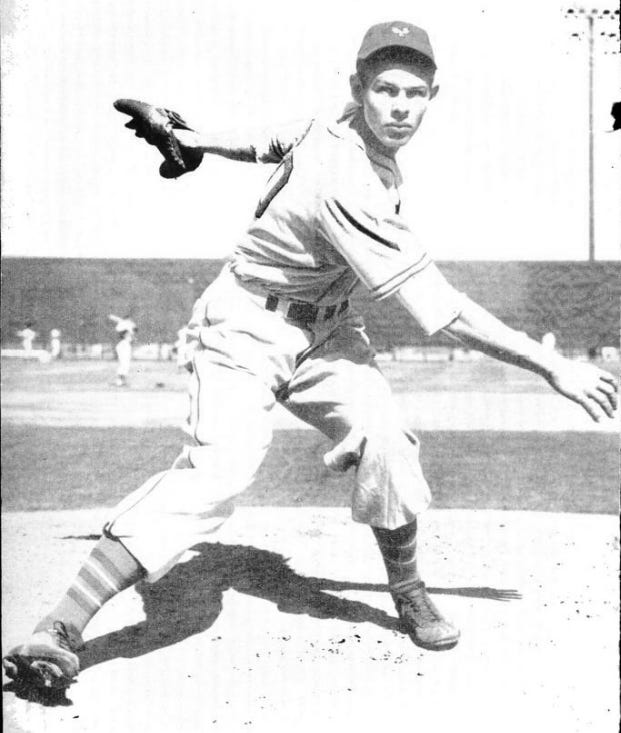
Before I dive in, I should offer a trigger warning to non-sports fans – somehow this post evolves into all manner of nostalgia, statistics and stories about my relationship to baseball, the history of New York baseball, the integration of the big leagues, and more, so be forewarned. Full disclosure: the photo above is not of yours truly, but of former New York Giants player Clint Hartung (no relation that I know of).
For those of you who aren’t into sports, there are also some stories about my childhood cat.
I’ve been remembering my dreams lately. Even worse, I’ve been remembering things I’ve done in real life.
On first look, I can come across as fairly straight – an aging white dude in a button down shirt who spends most of his time writing about serious matters like war profiteering or the prospects for nuclear armageddon. But like everyone else, there are other aspects to my personality and other experiences in my life that might be surprising to someone who judged me on first appearance. Some of the things I’ve done seem odd just because they happened in a very different context – a Republican (now deep MAGA) Republican suburb of Buffalo versus the liberal (although not as liberal as it once was) Upper West Side of Manhattan. Others are truly surprising, even frightening. But I’ll leave those for another day.
Below is one of the stories of my former life, complete with ample sidetracks and meanderings. It comes partly by way of dreams and visions, so I can’t swear that it is 100 per cent accurate. But this is how I remember it.
The other night I dreamed that my cat had died. And he did – in 1978.
Starting when I was about six years old, we had five cats in my house. It happened by accident.
As I’ve noted in other posts, I grew up in Lake View, New York, a small Republican suburb of Buffalo. Our neighbors, the Mayers, had a bunch of cats, one of which, called Pinky, used to mess up my mother’s flower garden. At first my Mom was irritated by Pinky, but eventually she grew to like her. Pinky was pudgy and gray with a pink nose — hence her name – Pinky.
Mrs. Mayer ended up giving Pinky to my Mom. It was a slightly unusual move. Back then most people adopted kittens rather than accepting fully grown cats as a gift.
The move proved to be even more unusual when we learned that Pinky was pregnant. A month or so after we got her (no wonder she was so pudgy!) Pinky had a batch of kittens, right in our kitchen. My siblings and I watched them being born. For a six year old, it was a bloody, slightly scary, totally fascinating process.
The kittens just kept coming. In the end there were four newborn kittens, and there were four kids in the family. So we each got to name our own cat. The cats ended up being named Marion – my sister Marion’s cat; Rocky – my brother John’s cat, named after Rocky J. Squirrel, the lead character in the animated Rocky and Bullwinkle Show; Angelo – my brother Jim’s cat, named after his friend Angelo, to tease Angelo for having a lot of body hair; and my cat, Whitey.
It’s embarrassing to tell people I had a cat named Whitey as a kid, without at least giving a little context. My cat was named after Whitey Ford, a pitcher for the New York Yankees who had his best season ever – 25 wins and four losses – in 1961, the year my cat was born. For a while Whitey Ford was right up there with Sandy Koufax as a top pitcher of his era – different styles, but comparable results. But unlike Koufax, whose name is legendary, Whitey Ford’s name has mostly faded into the record books, unless you are a diehard, lifelong Yankees fan.
As a kid I was a huge Yankees fan – and a huge fan of baseball generally. I literally learned to read from the endless number of sports biographies I took out of the local library. They were mostly about baseball players, although I was a big fan of the biography of Bill Russell of the Boston Celtics, even though I hated the fact that the Celtics won the NBA title almost every year when I was growing up, while my favorite team, the New York Knicks, were limited to their two magical championship years of 1970 and 1973, when I was 15 and 18, respectively.
In addition to learning to read from sports books, I swear I learned math from going over statistics on baseball cards and in the stats-rich Sporting News newspaper, which had all sorts of rankings of career and annual wins, losses, strikeouts and earned run averages, for pitchers; and home runs, batting averages and runs batted in for every day players.
I read the Sporting News before the era where more obscure stats like on base percentage or percentages of at bats ending in strikeouts were published, but I inhaled all of the baseball stats that I could. I memorized the lists of the top home run hitters and the players with the top batting averages in major league baseball history – well, at least white major league baseball history. Before Jackie Robinson broke the color barrier in major league baseball when he joined the Brooklyn Dodgers as their second baseman on April 15, 1947, all of the talented players of color were in the Negro Leagues. Some, like Robinson or the remarkable pitcher Satchel Paige, were able to make the transition into the American or National Leagues – but most did not.
But in 2024 Major League Baseball officially incorporated the statistics from the Negro Leagues into the major league record books. Josh Gibson, who spent most of his baseball career as the starting catcher for the Homestead Grays of the National Negro League, now officially holds the records for best lifetime batting average (.372) and best lifetime slugging percentage (.974), outpacing baseball legends Ty Cobb and Babe Ruth in those categories.
For those of you who were wondering, slugging percentage measures total bases per at bat. So if you get a lot of hits and hit a lot of home runs and other extra base hits, you will end up with a high slugging percentage. By contrast, batting average just measures hits per at bat, regardless of what kind, which means that Josh Gibson got a hit more than once every three times at bat for his entire career, a remarkable record.
I thought this entry was supposed to be about weird dreams and how I named my cat, but baseball seems to have taken over. I blame Whitey Ford and the 1961 New York Yankees for getting me into all of this.
I have one slightly more personal connection to baseball, in the person of Clint Hartung. We’re not related, but I occasionally get asked if we are by a baseball fanatic of a certain age.
I learned about Clint Hartung from Don Blachura, my local barber in my hometown of Lake View, New York. Don grew up in New York and in addition to being a barber he was a relentless weight lifter. His biceps were so big I was surprised he could lift his arms over his head. Anyway, early on he asked me if I was related to Clint Hartung, to which I responded “Clint Who?”
Clint Hartung was a baseball phenom of the late 1940s into the early 1950s. Hartung raised high hopes that he would be the next Babe Ruth. Like Babe Ruth, he started his career as both a pitcher and an outfielder. He signed with the New York Giants baseball team in 1941, but due to World War II he didn’t join the big league team until April 15, 1947.
Hartung’s arrival was highly hyped. He was six-foot–four, 215 pounds, and nicknamed the “Hondo Hurricane” after his hometown of Hondo, Texas. In 1946, the year before he joined the big league team, Hartung had a record of 25 and 0 as a pitcher and batted an amazing .565 in the Army leagues.
The fanfare surrounding Hartung’s impending arrival was intense, as sportswriter Bill Gallo of the New York Daily News noted at the time:
“In all my time in sports, I had never seen a ballplayer so heralded before he had played game one in the major leagues. Not DiMaggio… not Mantle… not Williams nor A-Rod or any of them. … (T)his guy, at first look, was Shoeless Joe Jackson, Ruth and Bob Feller all rolled up into one.”
New York was a serious baseball town at that point, before the Dodgers and Giants absconded to California. In the 1950s, New York had three major league baseball teams – the Brooklyn Dodgers; the New York Yankees, based in the Bronx; and the New York Giants, based at the Polo Grounds stadium in Upper Manhattan. The Yankees of Joe Dimaggio, Yogi Berra and Mickey Mantle were dominant in that period, punctuated by the Brooklyn Dodgers defeat of the Yankees in the 1955 World Series (the year I was born).
The key stars of the 1955 Dodgers were the pitcher Don Newcombe, the first black pitcher to win 20 games in the non-Negro major leagues; catcher Roy Campanella; Jackie Robinson; the center fielder and slugger Duke Snider; first baseman Gil Hodges; and shortstop Peewee Reese. Reese went on to be a well-known baseball announcer and Hodges was the coach of the New York Mets when they won their first World Series, in 1969. The 1955 Brooklyn roster also included a promising 19 year-old pitcher by the name of Sandy Koufax.
There was a sub-theme to the 1955 series. Brooklyn’s roster included three prominent black players – Robinson, Roy Campanella, and Don Newcombe. By contrast, the Yankees didn’t hire their first black player until that very year, 1955, eight years after Jackie Robinson joined the National League. That player was Elston Howard, an outfielder and catcher who went into the Negro Leagues in 1948, turning down football scholarships to Illinois, Michigan and Michigan State to do so. Howard got off to a hot start in the 1955 series, hitting a home run off of Dodgers ace Don Newcombe in his first at bat in the first game of the series.
That left the New York Giants, struggling to match their New York City rivals. They had plenty of talent – Willie Mays and Monte Irvin in the outfield, Sal Maglie on the pitching staff, Eddie Stanky in the infield – but keeping up with the Yankees and the Dodgers was a tall order nonetheless.
That’s where Clint Hartung came in. When he joined the Giants on April 15, 1947 – the same day Jackie Robinson joined the Brooklyn Dodgers – he was supposed to even the odds against the Giants’ New York rivals. Unfortunately Hartung ended up having a hard time hitting major league pitching, and he struggled with his control as a pitcher, issuing many more walks than strikeouts. In six seasons with the Giants he had a record of 29 wins and 29 losses as a pitcher – less than five wins per season. And he batted .238 and hit only 14 runs in his six years as a part-time outfielder with the Giants.
Hartung did have one small asterisk in the annals of baseball history. He was on third base when his teammate Bobby Thomson hit his famous “shot heard ‘round the world,” the home run that decided the 1951 Dodgers/Giants playoff game that determined who represented the National League in the 1951 World Series. Hartung was on base as a pinch runner, replacing Giant starter Don Mueller when he twisted his ankle sliding into third base. But he’s in the record books nonetheless.
Hartung was also memorialized by baseball statistician Bill James, who created the “Clint Hartung Award” for the most over-hyped rookie. The award ended in the 1980s when it was awarded to Brad Komminsk, an Atlanta Braves prospect tagged to be a record setting hitter and future baseball Hall of Famer before he stepped on a major league baseball field. It ends up his career stats were very Clint Hartung-like: a .218 batting average with 23 total home runs. But Komminsk went on to become a successful minor league manager in the organization then known as the Cleveland Indians (now the Cleveland Guardians), including a stint with the Bowie Baysox. Komminks discusses his playing and managing careers here.
I, too, would like to be an asterisk to baseball history, but I definitely can’t hit the curve ball anymore, and I wouldn’t be an ideal pinch runner. I do have some talent for helping other people succeed, but I’m not sure I could follow Brad Komminsk into the world of managing minor league baseball teams. If I ever do get a minor league gig, I would like to manage the Toledo Mud Hens, because I like their name. Not likely. But a person can dream.
My funniest Clint Hartung moment came in the 1980s, when I was a speechwriter for Bob Abrams, who was then the Attorney General of New York State. As a special treat, Bob let me join him on the state helicopter on a trip from New York City to Albany. It was the first leg of a trip to Massachusetts, where we were scheduled to witness Massachusetts Governor Michael Dukakis in action. Dukakis was running for president against George Bush the elder, and part of his campaign appeal was about what a great job he was doing governing Massachusetts. So the event we were going to was basically going to be a PR event showing him in action.
When we got to Albany to start the next leg of the trip, the Governor, Mario Cuomo, was on the tarmac waiting to get into the helicopter. Bob said something like, “meet my speechwriter, Bill Hartung.” Cuomo scratched his chin, looked to the heavens, and said “Hartung? Are you related to Clint Hartung?”
Not that I know of, but thanks for asking . . . .
Love the story!